
Many parts returned under warranty have not failed in service — they were damaged during fitting. Using the wrong tools or procedure, especially when tightening ball joint nuts, can deform the threads and void the warranty. Please read this before fitting a part or lodging a claim.
Support
Warranty
New parts warranty
All new parts supplied carry a 24 month / 40,000km warranty on parts only. Teknorot Australia Pty Ltd will not be liable for any consequential loss, damage, or loss of income because of the failure of goods sold.
Warranty is subject to our Conditions of Sale.
See our Conditions of Sale.
Correct fitting protects your warranty
Abnormal tightening dynamics due to socket/bit play
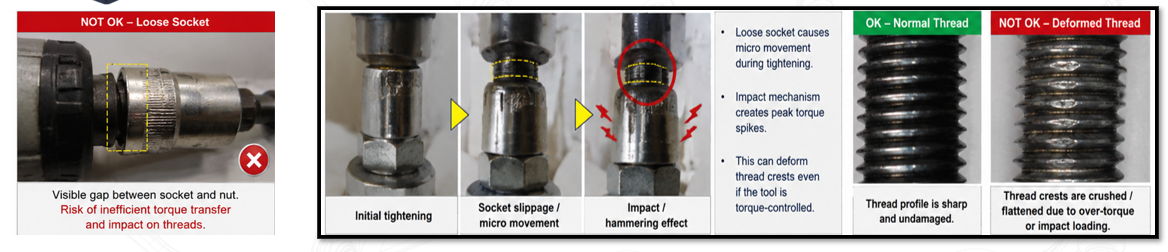
Review of the tightening process indicates that instability in the nut runner socket/bit interface may contribute to non-uniform torque transmission and localized impact loading. Such transient tightening conditions can lead to thread surface deformation even when nominal torque parameters are defined.
Torque-controlled tightening systems regulate nominal target torque; however, under unstable tightening conditions such as improper socket engagement, localized impact loading or repeated trigger application, transient torque peaks may occur at the thread interface before tool cutoff. Such conditions may result in localized thread deformation despite nominal torque setting compliance.
8 root causes of over-tightening during assembly
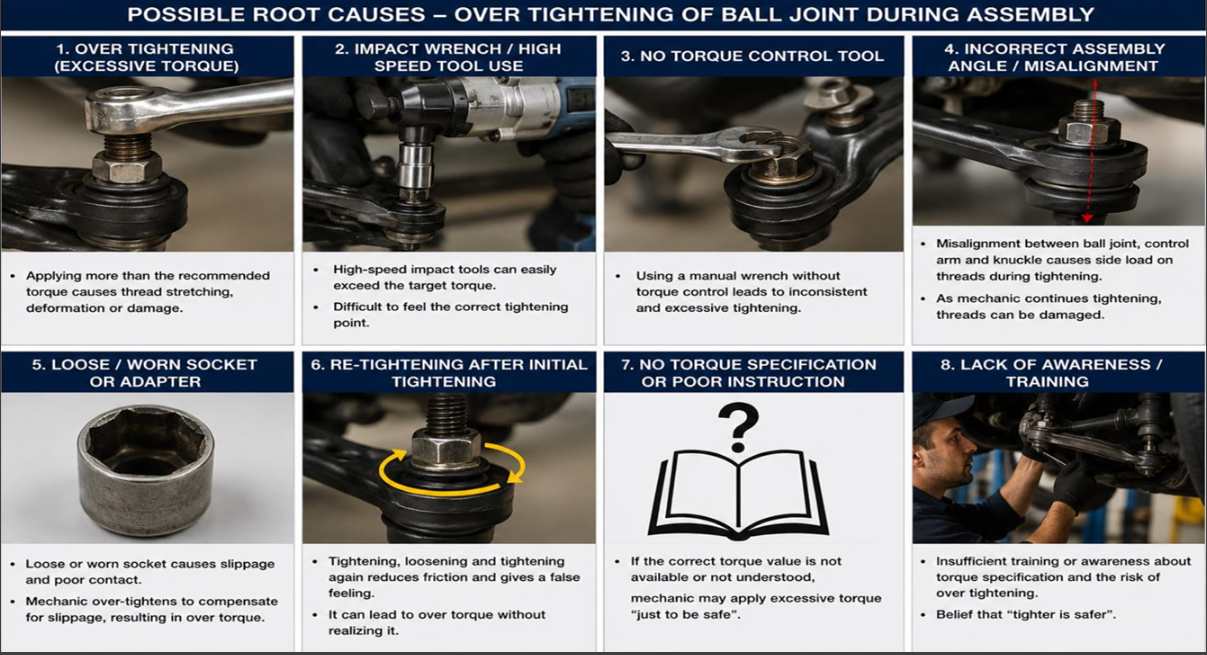
- Over-tightening (excessive torque) — applying more than the recommended torque stretches, deforms or damages the thread.
- Impact wrench / high-speed tool use — high-speed impact tools can easily exceed the target torque, and it is difficult to feel the correct tightening point.
- No torque control tool — a manual wrench without torque control leads to inconsistent and excessive tightening.
- Incorrect assembly angle / misalignment — misalignment between the ball joint, control arm and knuckle puts side load on the threads; continuing to tighten can damage them.
- Loose / worn socket or adapter — causes slippage and poor contact, so the mechanic over-tightens to compensate.
- Re-tightening after initial tightening — tightening, loosening and tightening again reduces friction and gives a false feel, leading to over-torque without realising it.
- No torque specification or poor instruction — without the correct torque value, excessive torque may be applied “just to be safe”.
- Lack of awareness / training — the belief that “tighter is safer”.
Always use a correctly sized, undamaged socket, a calibrated torque wrench and the vehicle manufacturer’s torque specification.
Why Hydro Bushes Leak
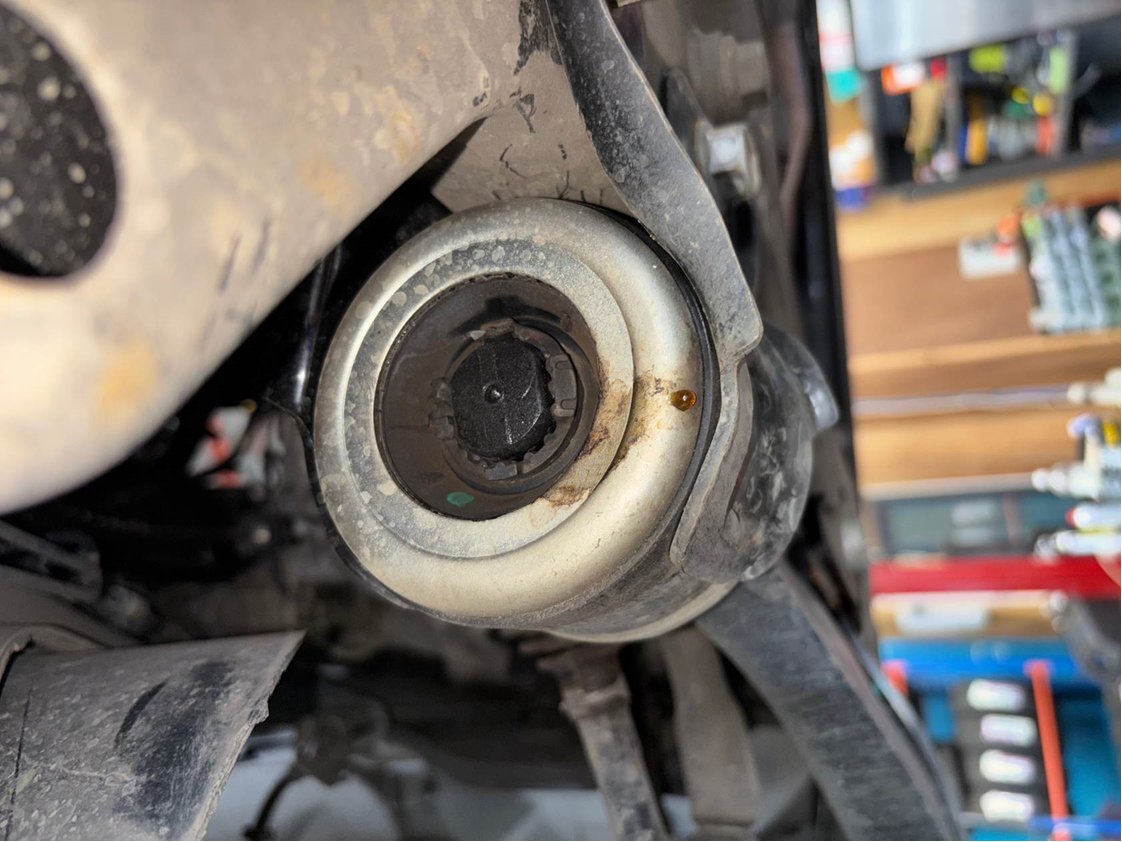
Failure 1 possibility
Natural Wear and Tear: These bushings are designed to absorb massive road impacts and dampen cabin vibrations. After 80,000–110,000 km, the constant twisting stresses cause the rubber to fatigue, crack, and eventually leak.
Failure 2 possibility
Improper Installation (Clocking Error): If this is a recently replaced Teknorot assembly and it failed early, it is highly likely the suspension bolts were fully tightened while the car was still raised on a jack or lift. Control arm fasteners must only be torqued when the vehicle is at its normal ride height (wheels on the ground). Tightening them in the air leaves the bushing permanently twisted at rest, rapidly tearing the internal fluid bladder.
Additional failure possibility
Severe Road Conditions: Striking heavy potholes, driving over rough terrain, or pushing a lifted suspension beyond its normal geometry parameters can rupture the fluid cavity prematurely.
When replacing the part at a workshop, ensure they target proper ride height before final torque, and always perform a wheel alignment afterward to prevent premature tire wear.
Lodge a warranty claim
To make a warranty claim, please complete our online claim form. If you have any questions, contact our customer service team at info@teknorot.com.au or call +61 2 51 377 011.