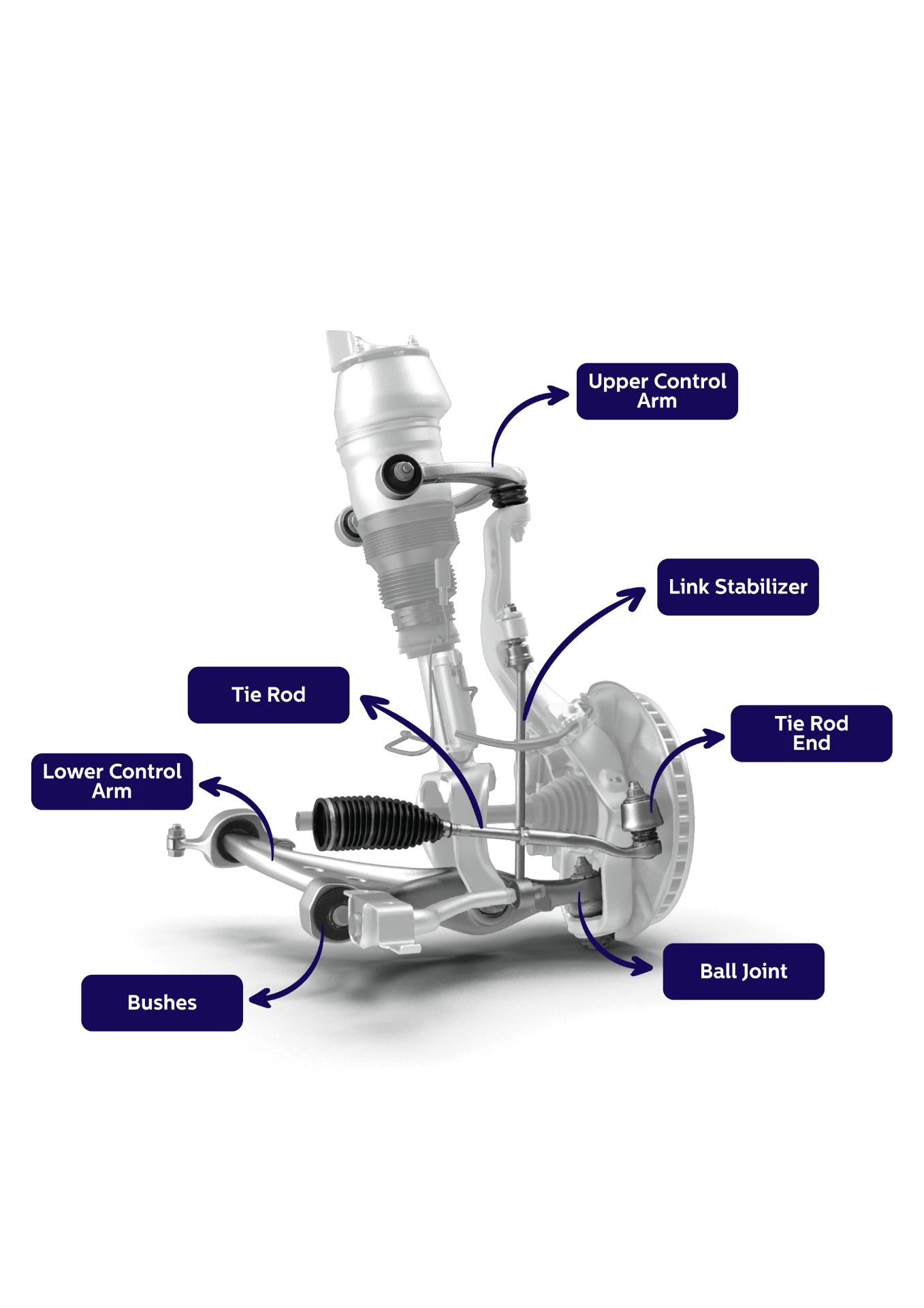
1Tie rod end
Also called a rod end or outer tie rod
 Example: T-151
The tie rod end is the pivoting link between your steering rack and the wheel hub. When you turn the steering wheel, the rack pushes or pulls on the tie rod, and the tie rod end lets the wheel turn smoothly while the suspension moves up and down.
Signs of wear: Loose or vague steering, a knocking noise over bumps, uneven tyre wear on the inner or outer edge, or the car pulling to one side.
2Axial joint
Also called an inner tie rod or rack end
 Example: HY-703
The axial joint screws into the end of the steering rack and connects to the tie rod end. It carries steering movement outwards to the wheels and allows the joint to articulate as the suspension travels.
Signs of wear: Play in the steering, clunking when turning at low speed, and wheel alignment that won't hold.
3Stabiliser link
Also called a sway bar link or anti-roll bar link
 Example: B-158A
Stabiliser links connect the anti-roll (sway) bar to the suspension. They help keep the car level through corners by sharing load between the left and right wheels, reducing body roll.
Signs of wear: Rattling or knocking over uneven roads or speed bumps, and more body lean than usual when cornering.
4Wishbone
A type of control arm, often triangular or A-shaped
 Example: R-745S
A wishbone locates the wheel relative to the car's body. It lets the wheel move up and down while keeping it in the correct position, using bushes where it mounts to the body and a joint where it meets the hub.
Signs of wear: Clunking on braking or acceleration, wandering on the road, steering wheel vibration, or visibly cracked or perished bushes.
5Ball joint
The suspension's pivot point
 Example: B-306
A ball joint works like a hip joint: a ball inside a socket that lets the hub pivot for steering while the suspension moves. It connects the control arm or wishbone to the steering knuckle.
Signs of wear: Creaking or knocking from the front end, uneven tyre wear, and wheel play when the car is lifted. A badly worn ball joint is a serious safety risk.
6Track control arm
A control arm supplied with its ball joint fitted
 Example: AF-409
A track control arm combines the arm and ball joint into one assembly. It controls the wheel's position and movement, keeping alignment stable as the suspension works. Replacing it as one unit saves fitting time and gives new bushes and a new joint together.
Signs of wear: Knocking, poor straight-line stability, steering pulling under braking and uneven tyre wear.